I'm Dreaming of a Rushed Christmas
Curtis Mort • December 29, 2025

Christmas Is Over Too Fast And That Exposes What We Really Worship

Christmas Day has passed. I have a couple relatives that pride themselves on how fast they can pull all the decorations down.  Going so far as to begin packing things up even before the wrapping paper debris is cleared.   The radio stations have moved on. Emails are piling up. Meetings are back on the calendar. For many of us, the most significant event in the Christian year is treated like a one-day interruption to the real business of life.


And this year, for reasons I can’t quite name, I'm feeling that loss more acutely.


The historic Church has always known something our modern culture has forgotten. Christmas is not a day. It is a season. A month of fasting, working, and preparation followed by twelve days of feasting, singing, telling stories, lingering, and letting the wonder of the incarnation settle deep into the bones.


We rush past it now. And in doing so, we reveal something uncomfortable about ourselves.


The Forgotten Shape of Christmas

Historically, "Christmas" begins on December 25 and runs through January 5, culminating on the 13th day (Jan. 6) in Epiphany. "Advent" prepared us through fasting and longing. Christmas answered that longing with joy, abundance, and rest.


This older rhythm once shaped not only churches, but cultural imagination.  It is why the great Christmas stories assume time, leisure, and lingering. In A Christmas Carol, the story does not end on Christmas morning.  It unfolds across days of feasting, reconciliation, generosity, and restored fellowship. Scrooge does not merely wake up changed. He spends days proving it, visiting, giving, eating, rejoicing. Christmas reforms his calendar before it reforms his character.


The same is true in American literature shaped by Christian memory. Washington Irving’s Old Christmas Essays describe households thrown open for days at a time, tables continually reset, work suspended as a matter of moral imagination. In Little Women, Christmas is not a one-day emotional peak but a season of visits, gifts, meals, and slow restoration of family bonds. These stories assume something we have lost.


Christmas, as a concept, takes time.


The logic is profoundly human and profoundly biblical. We do not merely acknowledge Christ’s coming. We celebrate it. We dwell in it. We let time itself bend around the reality that God has taken on flesh and now reigns as King.  In Christian cultures, work slowed. Feasts multiplied. Families gathered again and again. The calendar itself preached, "Christ has come. The world is changed. You may now rest."


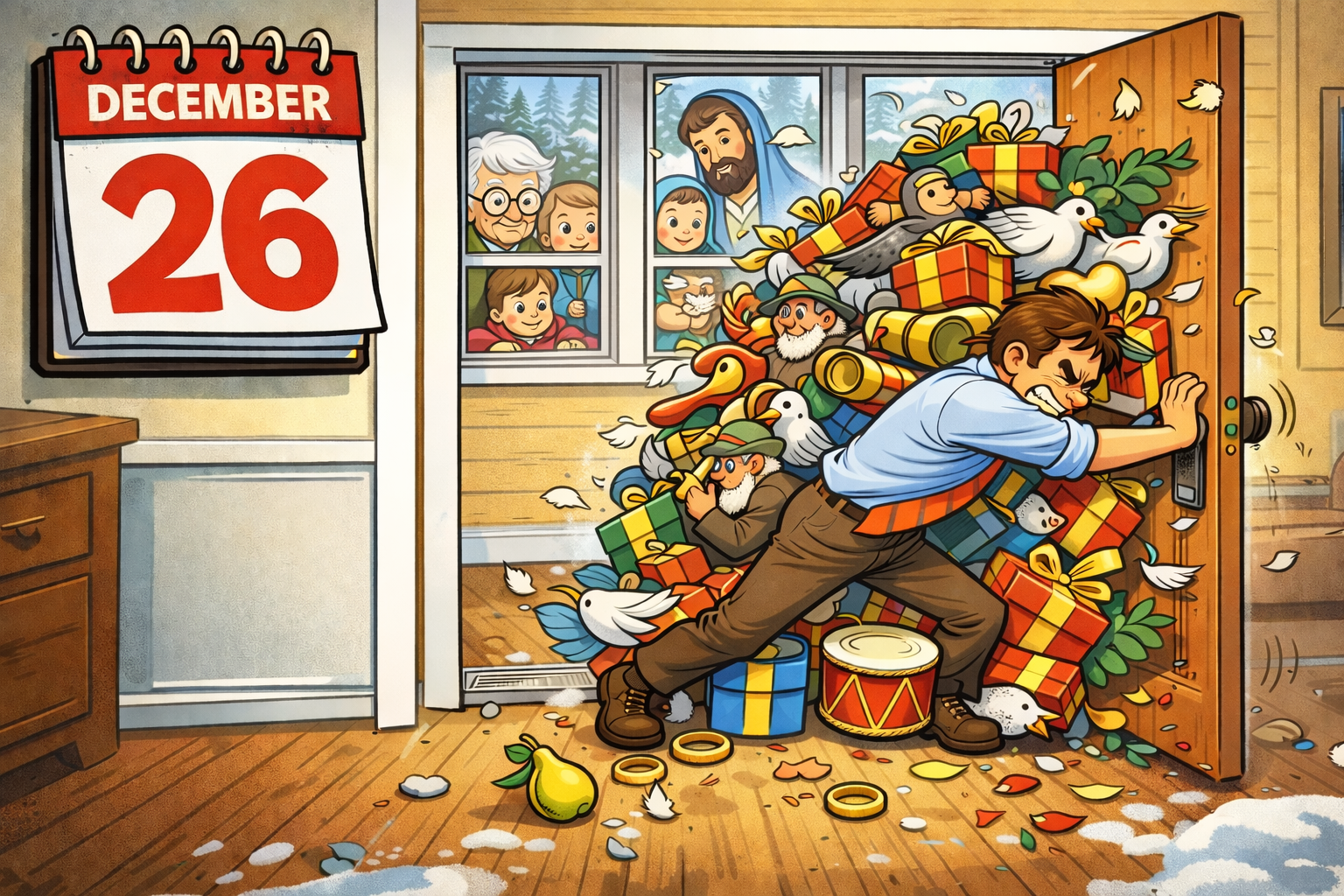
Contrast that with our present reality. December 26 feels less like the second day of Christmas and more like an overdue Monday. The stories we tell no longer assume lingering joy, because our lives no longer make room for it.


Even modern Christmas movies accidentally confess this loss, though they do so with a mug of hot cocoa and a knowing wink. The formula is always the same. A frantic professional woman or emotionally unavailable man is trapped in a soul-crushing job, allergic to small towns, and far too busy for joy. Christmas is an inconvenience. Family is complicated. Feelings are inefficient.


The plot then requires a forced slowdown. A flight is canceled. A car breaks down. A snowstorm intervenes. Providence, disguised as bad weather, drags them "home" kicking and screaming. They rediscover meals, conversations, fireplaces, and eye contact. This is all well and good. But notice the punchline. Everything must resolve by Christmas Eve or Christmas Day itself. One kiss. One reconciliation. One perfect dinner.  By December 26, the spell is broken. The town fades. The tree comes down. The credits roll.  What now?  Presumably, everyone goes back to their email inboxes and quarterly goals, now emotionally refreshed but still calendar-converted. Even Hallmark knows Christmas requires a pause. It just has no idea what to do with the second day of Christmas.  We have retained the sentiment of Christmas while abandoning the structure that once made that sentiment plausible. And sentiment, unsupported by time and practice, cannot survive for long.


Calendars Are Not Neutral

We like to imagine that calendars are practical tools, value-free and neutral. They are not. Calendars catechize. They teach us what matters.  What we schedule tells us what we love. What we refuse to interrupt tells us what we worship.  America’s calendar tells a clear story. We have holy days (the root words of "holidays"), but they are thin. Christmas is tolerated, not enthroned. It must fit between fiscal deadlines and productivity metrics. The faster we can get back to “normal,” the better.  And normal, in this case, is work. Money. Output. Efficiency.  This is not accidental. It is theological.


We have a national god, and his name is Mammon.


Here is the deeper problem. It is difficult to imagine an annual season of Christian celebration when we have already surrendered the weekly one.  Before the Church ever learned to feast for twelve days at Christmas, she learned to stop every seven. The Lord’s Day is the basic unit of Christian time. If we cannot pause weekly to acknowledge Christ’s kingship, it should not surprise us that an extended season of feasting feels impractical or indulgent.


Honoring the Sabbath is not a stuffy law obeyed with a sigh. It is not spiritual legalism or nostalgic traditionalism. It is a feast. A weekly celebration of resurrection. A declaration that Christ reigns and that we, His people, are not slaves.  The Lord’s Day says something radical every week. We stop because the King is on His throne. We rest because the work that truly matters has already been accomplished. We gather not because God is needy, but because He loves His people and delights to meet with them.


A church that treats its weekly services like they are an optional inconvenience to the otherwise important work, school, and sports calendars of its congregants will inevitably treat Christmas the same way.


The decline of Christianity’s cultural influence in the United States is often discussed in terms of politics, doctrine, or demographics. Those matter. But beneath them all lies something simpler and more insidious.  We stopped living like Christ is King of time.


When Christians allow the calendar to be dictated entirely by economic urgency, we silently confess that Christ may reign in our hearts, but not over our schedules. Not over our businesses. Not over our national rhythms. Our children notice. So do neighbors. So do employees.  A faith that never interrupts the workweek begins to feel ornamental. Optional. Private.


Here is the irony. We cannot actually escape the old rhythm.  The week between Christmas and New Year’s is famously dead. People are traveling. Offices limp along. Emails go unanswered. Meetings are postponed. Productivity drops whether we admit it or not.

We already have a lingering cultural pause from days gone by. We just refuse to name it.


What if, instead of pretending this week should be “normal,” Christians claimed it as what it already is: A season set apart. A time for feasting, hospitality, worship, storytelling, and rest.  Not laziness. Celebration.


It is worth noting that even in a thoroughly commercial culture, the instinct to protect Christmas lingers. This year Mr. Capitalism himself,  President Donald Trump, moved to give federal employees Christmas Eve, Christmas Day, and the day after Christmas off, it was a small tip of his hat to  something true.


Christmas is not a speed bump. It is a season.


The state may stumble toward this instinct for pragmatic reasons, but the Church should embrace it unapologetically for theological ones.  Christians are often uneasy with feasting. It feels indulgent. Unproductive. Slightly embarrassing.  Scripture disagrees.

Feasts mark victory. Feasts announce abundance. Feasts declare that the King has come and the famine is over.


The incarnation is not an idea to be acknowledged. It is a reality to be celebrated. God has taken on flesh. Heaven has invaded earth. History has turned a corner.  A one-day holiday cannot bear that weight.


A Call to Reclaim the Calendar

At this point, it feels a little bit like I'm firing a red-rider at a panzer.


But (PEW! PEW!) this is not primarily a call for new laws or national mandates. It is a call for repentance and imagination.

Christian fathers and mothers should reclaim the Christian calendar in their homes. Mark the days. Keep the Lord’s Day holy as a delight, not a burden. Let Christmas spill past December 25. Teach children that time itself belongs to Christ.


Christian business owners should have the courage and faith to structure their companies around Christ’s calendar, not merely Wall Street’s. A protected Sabbath and a twelve-day Christmas season signal something powerful to employees.


We work for more than profit. We answer to a higher King.


Churches should stop treating Christmas like a finale and start treating it like the opening movement of a long, joyful song. Nearly two full weeks of services, meals, prayers, psalms, and fellowship would preach more loudly than a thousand slogans.


For my part, I find myself waging a quiet, almost imperceptible rebellion against all of this.  Nothing dramatic. Nothing loud. Just stubborn faithfulness.  I keep giving gifts after December 25. I keep saying "Merry Christmas" long after the culture has moved on. When someone asks how my Christmas went, I answer, “I’ll let you know when it’s over.”


We have scheduled family gatherings throughout the season, not just for one compressed day. Meals. Evenings. Christmas hymns.  Time that lingers. Time that feels inefficient. Time that reminds us that Christ did not come to fit neatly into a planner.


It is not a protest meant to scold anyone. It is simply a refusal to rush past what deserves to be lingered over. A way of teaching my children, and perhaps reminding myself, that Christmas is not something we get through. It is something we inhabit.


If calendars shape loves (and they do), then I want my calendar to preach, even in small ways, "Christ has come. The King is here. The feast is still going."


Calendars shape loves and loves shape lives.


If Christ is at the center of the calendar, He will not remain at the margins of culture for long. Time itself will bear witness. Children will grow up assuming that Christ’s reign is normal, public, and celebratory.  Recovering the twelve days of Christmas begins with recovering the weekly joy of the Lord’s Day. From that foundation, the larger feasts make sense.  The Church does not need to invent new rhythms. We need to remember the ones we were given, and to live like the incarnation actually changed the world.


Because it did.


Isaiah 9:6–7


For to us a child is born,

to us a son is given;

and the government shall be upon his shoulder,

and his name shall be called

Wonderful Counselor, Mighty God,

Everlasting Father, Prince of Peace.

Of the increase of his government and of peace

there will be no end,

on the throne of David and over his kingdom,

to establish it and to uphold it

with justice and with righteousness

from this time forth and forevermore.

The zeal of the LORD of hosts will do this. (ESV)

By Curtis Mort December 9, 2025
Not long ago I pulled out our wedding album. I had not looked at it in years. My younger son, Spurgeon, was asking questions about the day, so I sat at the kitchen table and flipped through the pages, pointing out faces, retelling stories, laughing at how young we looked. Then I came to the photo of my groomsmen. Eight men stood there shoulder to shoulder with me, all of us young, confident, and certain we would walk through life together. These were the brothers I thought I would grow old with. These were the men I could not imagine losing touch with. But as I stared at that photo, the realization settled on me with surprising heaviness. Out of the eight, I only maintain meaningful contact with one of them today. One. The rest have faded into the background of my life like landmarks. Some conflict, but not a great deal. Mostly miles added, convictions deepened, seasons changed, kids grown, jobs shifted, and proximity dissolved. The men who once stood beside me at one of the most significant moments of my life had quietly drifted into other circles, other priorities, other worlds. I have drifted too. It is strange how a single picture can tell the truth you never stopped to consider. Back then I mistook proximity for loyalty, constant fun for constancy, and shared youth for shared conviction. We were in the same season, so we believed we would stay in the same story forever. But middle age knows better. It reveals that many friendships from youth were built on the scaffolding of convenience. When life moved on, the scaffolding fell away, and so did the friendship. As I stared at those faces in the photo, I felt a tug of sadness. But alongside that sadness came clarity. Those men were not impostors. They were not disappointments. They were simply fellow travelers for a particular stretch of road. Our lives had overlapped, not intertwined. We had stood in each other’s weddings, but we had not forged the kind of friendship Proverbs describes. We had never built the long-term habits of candor, prayer, and counsel. We loved each other, but we did not really sharpen each other. The fact that only one remained was not a failure of affection. It was a revelation of depth. When you grow up in modern America, friendship is simply assumed. You inherit it. You do not choose it. Public schooling creates an artificial ecosystem where proximity does most of the heavy lifting. Your friends are simply the other kids who live in your zip code and ride your bus. You bond over superficial commonalities because you all share the same cafeteria, the same geometry homework, the same Friday night lights. Friendship in youth is built on convenience and context. Nothing becomes very different in early adulthood. You enter the survival years. You get married. You bear children. You work long hours. You fall asleep during movies. You lock arms with whoever is also drowning in diapers and debt and exhaustion. The similarities are comforting. They feel like solidarity. But very often it is not friendship in the biblical sense. It is trauma bonding. It is the camaraderie of fellow soldiers ducking their heads in the same trench. You do not have the time, energy, or maturity to ask the deeper questions. You do not stop to consider whether these people actually share your loves, your convictions, your vision of the good life. You are simply busy. You gravitate toward the people who are in your season because proximity and survival make the choices for you. Then something changes. There are some challenges no one warns you about when you are young. Middle-aged friendship is one of them. No one tells you that this will be one of the quiet crises of your late thirties and forties. You drift into it the same way you drift into adulthood itself: slowly, unconsciously, and without a plan. Middle-aged friendship usually does not die with a bang. It dies with a full calendar. With one more rescheduled dinner. One more “we should get together soon.” One more group text that never quite lands on a date. Your children grow. They become more independent. Your career stabilizes or shifts. The fog lifts. One day you wake up at 40 and realize most of the people who know your stories do not actually know your soul. They were simply there when you happened to be young. You are surrounded by people you have known for years and yet you do not truly know them. Worse, you realize you are not deeply known. In many cases the glaze of youthful ignorance dissolves and you see plainly what you did not have the margin or maturity to see earlier. Some of the people you once considered "close as a brother" are not aligned with you in the things that matter most. The political trivialities, the moral divergences, the theological differences, the lifestyle misalignments, the work ethic gaps, the seriousness about life, marriage, holiness, and responsibility, all become unavoidable fault lines. The people you once considered to be like family are busy or drifting in directions you never intended to go. You are left holding a quiet, unsettling realization: I do not know how to build the kind of friendships I actually need. And then the deeper ache comes. You begin to understand that your time is not elastic. Your soul is not bottomless. Friendship is a limited stewardship. And you do not have unlimited space to carry one-sided friendships, low-commitment acquaintances, or people who do not choose you back. Middle-aged friendship forces you to see something you could not see before. True friendship is not defined by who has been around you the longest, but by who is willing to walk with you with constancy, candor, and counsel. The book of Proverbs becomes painfully practical in this stage of life. “A friend loves at all times.”
Proverbs 17:17 “A friend sticks closer than a brother.”
Proverbs 18:24 (second half) “A friend wounds faithfully.”
Proverbs 27:6
(“Faithful are the wounds of a friend…”) “A friend gives earnest counsel.”
Proverbs 27:9
(“…the sweetness of a friend comes from his earnest counsel.”) “A friend sharpens you.”
Proverbs 27:17
(“Iron sharpens iron, and one man sharpens another.”) This is not proximity. This is intentionality. It is effort. It is choosing. Mel Robbins helpfully frames the "three pillars of friendship" as proximity, timing, and energy. These help explain why young friendships form so easily and why midlife friendships break so suddenly. Proximity fades as families move, schedules tighten, and obligations multiply. Timing diverges as some raise toddlers and others launch teens or start over in their careers. Energy shifts when beliefs sharpen, habits change, or one person grows while another stays still. In youth, you assume friendship. In middle age, you discover its real cost. I think it would be more accurate to call Mel's formula the "three pillars of companionship." Scripture pushes the definition of friendship deeper. You cannot have many true friends. Companions are plentiful. Friends are rare. Friendship requires discovery and forging. Discovery is the foundation. It is the moment when two people say, “You too? I thought I was the only one.” Forging is the lifelong work of commitment, vulnerability, rebuke, availability, and shared counsel. The three biblical pillars are affinity, intentionality, and sacrifice. This is where midlife friendship becomes spiritually dangerous. It's easy to become bitter. Easy to resent people who do not reciprocate. Easy to hold on to relationships that should be allowed to die a natural death. Easy to become cynical and self-protective. But, when you see the biblical vision of friendship, you feel two things at once: longing and crushing inadequacy. Longing, because true biblical friendship must be fought for and is hard to come by.
 Inadequacy, because we recognize we have not been the friend we long to have. This is why the gospel matters for friendship. Jesus Christ is the friend Proverbs points to. The friend who always lets you in and never lets you down. The friend whose wounds heal rather than harm.
 The friend who cleaves to you at infinite cost.
 The friend who faced hell rather than lose you.
 The friend who does not flatter you, but sanctifies you. The friend who knows you fully and loves you still. His friendship frees you.
 It frees you from needing other people to carry the weight of your identity.
 It frees you from being paralyzed by rejection.
 It frees you to love without fear.
 It frees you to choose friends wisely and release friendships graciously.
 It frees you to become the kind of friend you have always needed but rarely been. Middle-aged friendship is difficult because it is the first time in your life that you must build friendships deliberately rather than inherit them by accident. It is the stage where you must confront yourself, your habits, your selfishness, and your relational immaturity. It is the place where Christ’s friendship becomes not a doctrine to be recited, but a lifeline to be held. And it is also the place where the church becomes radiant. Christian friendship is where two people share the deepest affinity possible, the love of Christ, and yet can be gloriously unlike each other in almost every other way. Christ opens up friendship across age, personality, income, ethnicity, background, and temperament. This friendship is engineered by a sovereign Host who chooses the guests for His feast. You have not chosen one another.
He has chosen you for one another. Oddly enough, the ache of that wedding photo has become a gift to me. It has cleared space in my soul. It has reminded me that losing proximity is not the same thing as losing love. It has reminded me that Christ is still writing the story, bringing into my life men who share not only my past circumstances but my present convictions and future hopes. Middle age strips away illusions. It shows you that convenience was never covenant. Proximity was never loyalty. Shared circumstances were never shared convictions. It is painful, but it is also purifying. Because now you can choose.
 Now you can love with intention rather than accident.
 Now you can build friendships not from survival but from wisdom and joy. If you feel the ache of friendships that have faded, do not mistake it for failure. It is the Spirit clearing space. It is maturity arriving. It is the Master Gardener pruning so that true fruit can grow. To my middle-aged brothers and sisters…step into this season with courage that flows from your faith.
 Choose well.
 Love deeply.
 Speak truthfully.
 Invest in the few who invest in you. And remember this: Before you ever forged a single friendship on earth, Heaven forged one for you.
 The Son of God walked into Gethsemane and up the hill of Calvary so that you could sort out mere companionship from covenant friendship. Let these four words come straight out of heaven and sink deep into your soul: You are not alone. And because of that, you are free to become the friend your future friends will thank God for.
By Curtis Mort November 16, 2025
Soft Parenting and Soft Pulpiteering: Two Orchards, One Root System
By Curtis Mort November 7, 2025
How 9Marxists Learned to Fence Out Kids and Vote In Pagans
By Curtis Mort November 1, 2025
The Latin phrase alma mater means “nourishing mother.” It’s a beautiful and sobering thought. It implies that our educational institutions are not mere dispensers of facts, but mothers in the truest sense: they feed, nurture, and form the minds and hearts of our children. A child will always become, in large measure, what he is nourished by. The content of that nourishment, the ideas, values, and worldview imparted, becomes the substance of the soul. This is why Martin Luther, the reformer, famously said, “I would advise no one to send his child where the Holy Scriptures are not supreme.” He understood that education is discipleship, and that to entrust a child’s formation to an institution that cannot distinguish light from darkness is to hand them to a mother who nurses them on poison. Mt. Vernon’s Confusion The Mt. Vernon School Board recently reaffirmed its decision to allow an LGBTQ+ student club to meet on campus, defending the move as a matter of fairness and legality. In their statement, they equated the LGBTQ+ and Friends club with groups like Boys of Faith, Girls of Grace, and PAWS Wrestling, as if all were morally and educationally equivalent. This reveals something much deeper than a policy decision. It shows that those entrusted with shaping the next generation cannot tell the moral difference between a group dedicated to physical discipline or spiritual formation and a group centered on adolescent discussions of sexual identity and preference, often without the guiding influence of mature adults. This is not neutrality. It is moral blindness. When those who claim to “nourish” our children cannot distinguish between food and poison, the community must take notice. Christians, You Are Responsible Parents, particularly Christian parents, cannot shrug at this. You are responsible for what nourishes your children, body, mind, and soul. To send them into an environment that celebrates confusion and calls it compassion is to surrender your God-given duty to disciple them in truth. You are not powerless. You are called to shepherd your children’s education toward truth, goodness, and beauty. Given recent events, here is the hard truth staring you in the face: You can’t depend on the “nourishing mother” of the public school to feed them rightly. Education that was once rooted in shared moral foundations, has become a mission field, or worse, the battlegrounds for the moral imagination of the young citizens of our community. The issue before us is not merely the existence of a club. It is the philosophy of education that now animates my alma mater , a mother who feeds, but no longer nourishes. Christians, it is time to remember that neutrality in moral formation does not exist. There are only two tables: the Lord’s, and the world’s. Your children will be nourished at one of them.
By Curtis Mort October 31, 2025
By Curtis Mort October 29, 2025
SNAP, TANF, and the Death of the Christian Household
By Curtis Mort October 23, 2025
For generations, our communities flourished because faith, family, and shared moral conviction formed the soil beneath them. But as we try to enjoy the fruit without the tree — kindness without Christ, virtue without God — the center begins to wobble, and the only way forward is to replant our roots in Him.
By Curtis Mort September 26, 2025
Enemy and Escort - September 26, 2025
By Curtis Mort September 24, 2025
This is a subtitle for your new post